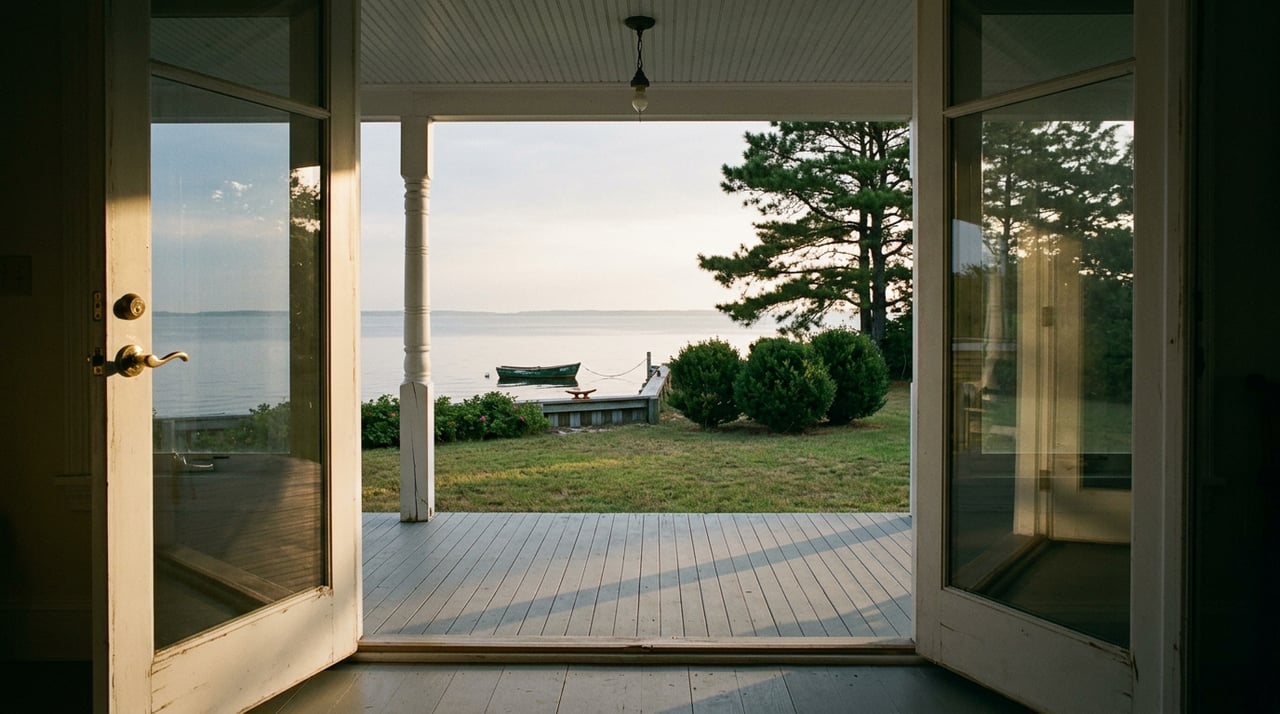
In a Penobscot Bay Press report, Stonington Select Board Chair Donna Brewer said at the town's February meeting: "People keep asking me what we're going to do with the Odd Fellows Building. I'll say that we've got some plans, but they don't want to hear that."
She's right that people keep asking. The three-story Odd Fellows Hall sits on Main Street with the Fish Pier behind it, and anyone who walks past it more than once a week has probably wondered the same thing: why is this building still empty two years after the town bought it? The honest answer isn't indecision. It's sequencing. The hall's future depends on money that hasn't fully landed yet, for a shoreline project that depends on a pier project, which only started moving in early 2026 after years of waiting on federal appropriations. What looks like one slow renovation is actually three infrastructure projects that have to click into place in a specific order, and the building on Main Street is the last piece, not the first.
The building came first, but it was never really about the building
As the Bangor Daily News reported, Stonington voters authorized borrowing money to help buy the Odd Fellows Hall back in 2021, and the reasoning at the time had less to do with the building itself than with what might happen if someone else got there first. Then-Town Manager Kathleen Billings told the paper that residents feared a private buyer might add a private dock on the property, which sits on shore frontage right next to the town's skiff docking space at the municipal Fish Pier. Losing that access permanently was the real risk voters were trying to avoid.
Senator Susan Collins secured $394,000 toward the purchase in the Fiscal Year 2022 Housing Appropriations bill, and the town closed on the building in the summer of 2024 for a total of $525,000. The Independent Order of Odd Fellows had used the hall for more than a century before that. The local lodge is still active. It simply relocated to a new building in nearby Oceanville, built in part with proceeds from the sale.
Since the purchase, one piece of the building's future has already been settled: the town's sanitary district offices are moving into the basement. Everything above that is still open. Retail, offices, a public meeting space, apartments. All of it has been floated. None of it has been decided, because deciding what goes upstairs is the easy part. The hard part is what happens outside, on the shoreline behind the building, and that part is tangled up with two other projects that had to get funded first.
The plan Stonington's own economic director laid out in three steps
At the Select Board's February 9 meeting, Economic and Community Development Director Linda Nelson gave the clearest public explanation of how these pieces fit together. She described it as a staged plan, first formulated back in 2020 and 2021, that only started moving once federal funding for the first stage came through.
- Dredge the harbor around the Fish Pier. A $2 million appropriation, championed by Senator Angus King, Senator Collins, and Representative Jared Golden, will remove the sediment, silt, and debris that has built up around the pier and restore its original berthing depth.
- Reconstruct and raise the Fish Pier itself, using a second grant that Nelson described as still pending approval at the time she spoke.
- Integrate those improvements with a plan to use the waterfront adjacent to the Odd Fellows Hall, which is where the new pier, ramp, and additional float space come in.
That third step is the one residents keep asking about when they ask about the building. It isn't a separate question. It's the last domino, waiting on the first two to fall.
What's actually moving, and what's still waiting on money
As of the most recent public updates, the picture looks like this. The $2 million dredging appropriation is secured, folded into the federal spending package that funds the government through the fiscal year ending October 1, 2026, but Nelson said in February there was no firm start date yet for the project. The causeway work has its own funding: $12 million, also announced by Senator Collins in February, to raise the two causeways connecting Deer Isle, Little Deer Isle, and the Deer Isle-Sedgwick Bridge, the only road link the island has to the mainland.
Closer to town, part of Oceanville Road has already been raised as a resiliency measure. The town wants to raise two more roads near Burnt Cove harbor next, along with the Fish Pier itself. And the Odd Fellows Hall shoreline work, the piece that would add float space for dinghies and stabilize the bank behind the building, is still waiting on outside money. By June, the town had submitted an application for that $1.22 million project to the state's working waterfront infrastructure fund. Nelson told the Bangor Daily News in June that the project was "totally dependent on outside funding," the same as most of the other resiliency work Stonington and towns like it along the Maine coast are trying to pull off without the tax base to cover it alone.
Nelson put it plainly to local reporters back in June: future uses for the building's upper floors would be discussed at Select Board meetings in the weeks ahead. That conversation can't really move forward until the town knows what physical footprint it's working with once the shoreline plan is settled. You can't decide what goes on the second floor of a building whose waterside foundation work isn't finalized yet.
Why the harbor itself makes this more than a building question
It helps to remember what's actually at stake behind Main Street. Stonington's Fish Pier is a compact operation: roughly 70 parking spaces, 70 skiff tie-up spots, and five seafood dealers working out of a municipally-owned site whose user fees cover its own operating costs. The town has about 350 lobster license holders, though not all of them are actively fishing, and in 2025 Stonington brought in more than $49 million in lobster landings, making it Maine's most valuable port for the year.
Assistant Harbor Master Dana Webb described the access problem in terms anyone who has tried to find parking downtown in August would recognize, just with higher stakes. Older fishermen are retiring, he said in a Fox Bangor report, but more people are trying to get into the industry than are leaving it, and all of them need somewhere to tie up. Add in the lingering damage from back-to-back storms in January 2024, and the case for more float space stops being a nice-to-have and starts looking like basic maintenance for a working harbor that can't afford to lose capacity.
Nelson framed the Odd Fellows Hall project as a way to solve several problems at once: more float space for dinghies, a stronger shoreline for Main Street, and public access preserved on a piece of waterfront that could easily have gone private. That's the same logic that drove the 2021 purchase in the first place. It has taken several years, three levels of government, and two more infrastructure projects to get this far.
What this looks like from Main Street
None of this happens loudly. There's no ribbon cutting scheduled, no firm date on the dredging, no vote yet on whether the second floor becomes apartments or a meeting hall. What's actually happening is a sequence, and it's a sequence that finally started moving in early 2026 after years of applications and appropriations bills. If you want to watch it unfold in real time, the Select Board meetings are where it's happening, not in any single announcement.
Stonington's identity has always run on layers stacked on top of each other. Granite quarrying gave way to lobstering without erasing it. Haystack Mountain School of Crafts brought in artists without displacing the fishing fleet that still fills the harbor. The Odd Fellows Hall is just the latest version of that pattern: a building that used to house a fraternal lodge, purchased to protect public water access, now waiting on federal grants to fund the shoreline work that will finally let the town decide what the upstairs becomes.
If you're watching Hancock County's coastal towns for reasons that go beyond curiosity about a building on Main Street, whether you're weighing what a waterfront parcel actually comes with, or trying to understand how a small working harbor manages growth and access at the same time, Stephanie Henry has spent her career in these towns and can walk you through what's actually on the ground, not just what's on the listing sheet.